


See all results for ""

 Anytime
 Tiếng ViệtEnglish
 日本語
日本語 한국어
한국어 简体中文
简体中文 Français
 Deutsch
 Español
 Italiano
 Русский


 Login for Corporates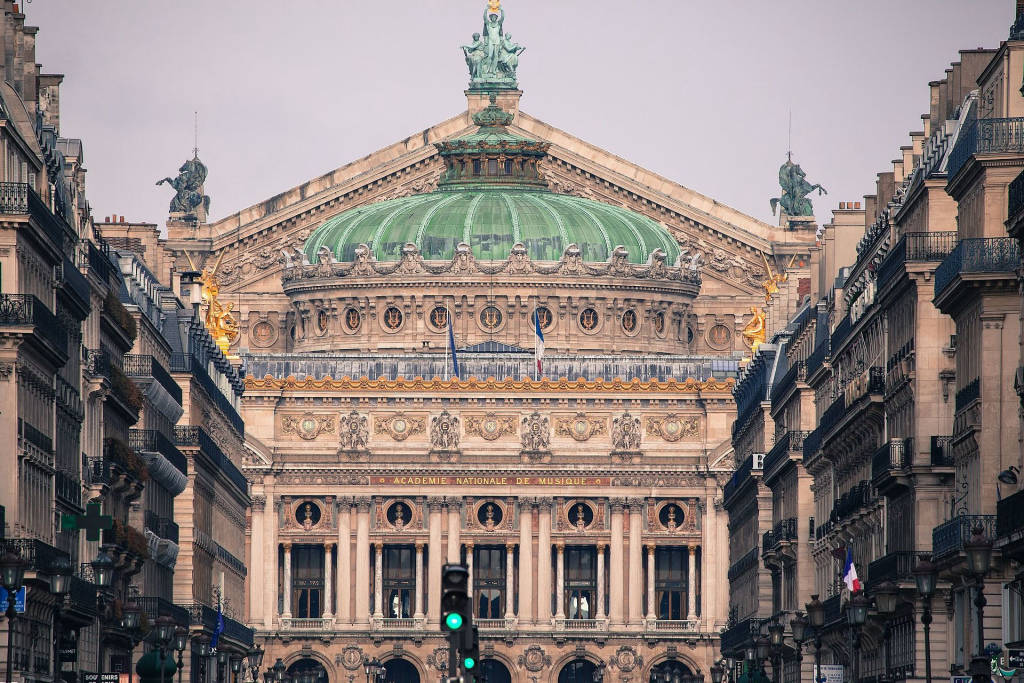
Palais Garnier Theater
 Pl. de l'Opéra, 75009 Paris, France
Palais Garnier Theater (also known as Opera Garnier) is one of the most magnificent architectural works of France.
The Palais Garnier Theater (also known as Opera Garnier) is one of the most influential architectural works of art in France. The theater is also said to be a symbol of the city of Paris, along with the Louvre Museum, Notre Dame Cathedral or the Sacré-Coeur Church. Palais Garnier Theater is said to be the largest theater in Europe with an area of 11,237m2 and a capacity of up to about 2,000 people.
At the request of King Napoleon III, this work was designed and supervised by architect Charles Garnier. Construction began on July 21, 1862, but it took 13 years to complete and officially opened to the public on January 5, 1875.
In addition to the sophistication and complexity of the building's design, there are many other reasons that have prolonged the construction of the theater.
At the location of the theater, there is a high groundwater level, while the theater needs a deep basement. Therefore, to overcome this problem, Garnier designed a double foundation, consisting of a water channel and a giant concrete water reservoir, both to help reduce the pressure of the external groundwater flow on the floor walls. tunnel, both acting as a reservoir for water in case of fire. It took Garnier 7 months to pump all the water out and complete the construction of the foundation.
The legend that the opera house was built on an underground lake also started here. This detail became the inspiration and was used in the novel The Phantom in the Theater by writer Gaston Leroux.
The Franco-Prussian War (1870-1871), the fall of the Second Empire, the change of government, and the high cost of construction were also the reasons that caused the completion of the theater to be significantly delayed.
The Palais Garnier Opera House was built to serve the French aristocracy, where lavish parties or formal dinners often took place. Therefore, the theater has splendid architecture, solid structure and sophisticated design. This is also the point that makes the Palais Garnier stand out and special.
Palais Gariner is designed in an eclectic "Napoléon III" style. The opera house is a harmonious and skillful combination of elements from the Baroque style, Palladio's classical Roman/Greek architecture, and Renaissance architecture. The building was built according to axial symmetry, combined with modern techniques and materials of the time. Both the façade and the interior are meticulously and densely decorated with various colors and materials, such as marble, porphyry, and gilded bronze.
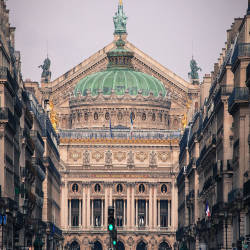
The main facade is located on the south side of the theater at Place de l'Opéra. As many as 14 painters, engravers and 73 sculptors, used 17 different materials to create reliefs, columns and statues, many of which depict Greek gods, ornate. for the facade of the building. Each of these details can be considered a separate work of art.
The two most prominent statues here are the two gilded bronze statues of Charles Gumery L'Harmonie (Hoa Thanh) and La Poésie (Poetry), located on two floors ( avant-corps ) left and right. Between the pillars are rows of bronze busts of many great composers such as Rossini, Beethoven, Mozart...The foot of the two lofts is decorated with four large statues, representing theatrical elements: Poetry (also known as Hoa Thanh, Harmony), Musical Instruments (Instrumental music), Ca Vu (Dance), and Drama (Drama).
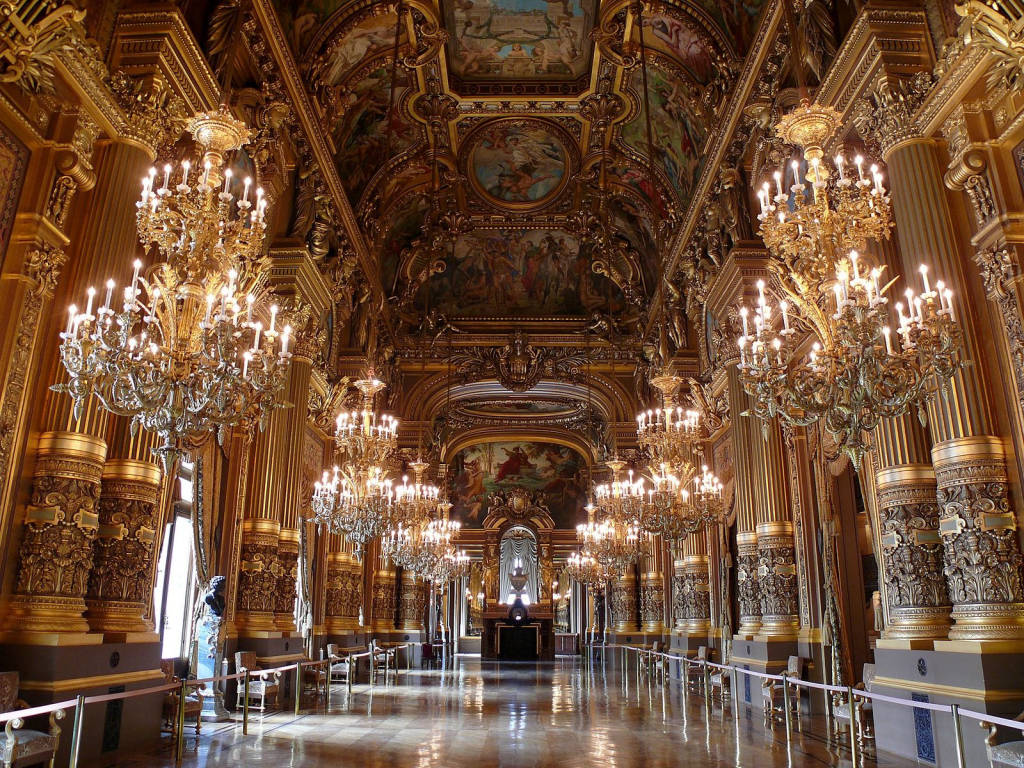
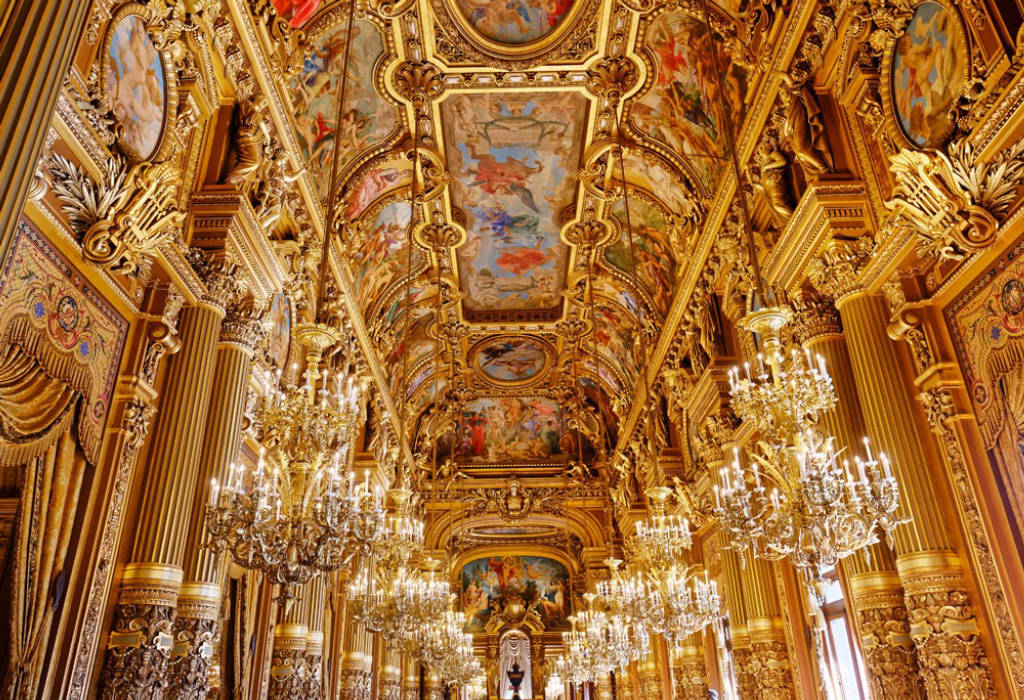
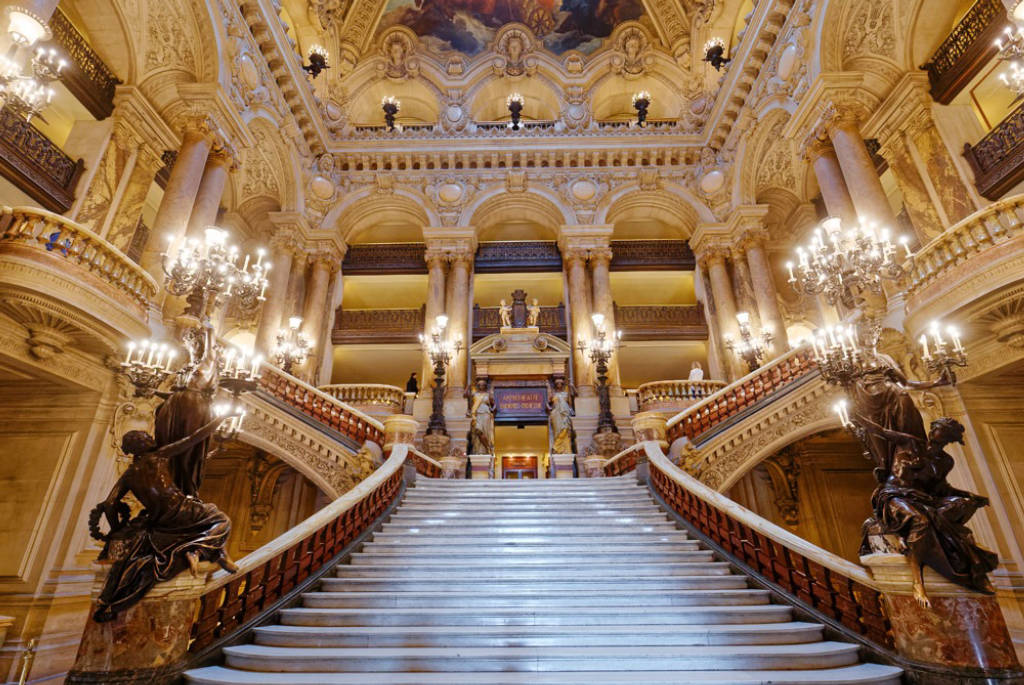
The interior of the building is also decorated equally sophisticatedly and splendidly. The lavish Baroque style is evident in the extensive use of materials such as velvet, gilding, and ornamentation of angels and fairies.
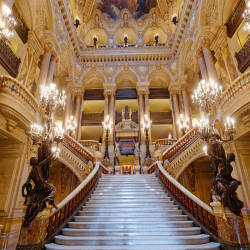
The luxurious marble staircase, the glittering handrails of all colors, and especially the length of up to 30 meters are among the highlights of the theater interior. The corridors, stairs and alcoves are designed interlaced with each other to increase the usable area of the space, allowing a large number of people to move or stand to communicate easily and without restriction.
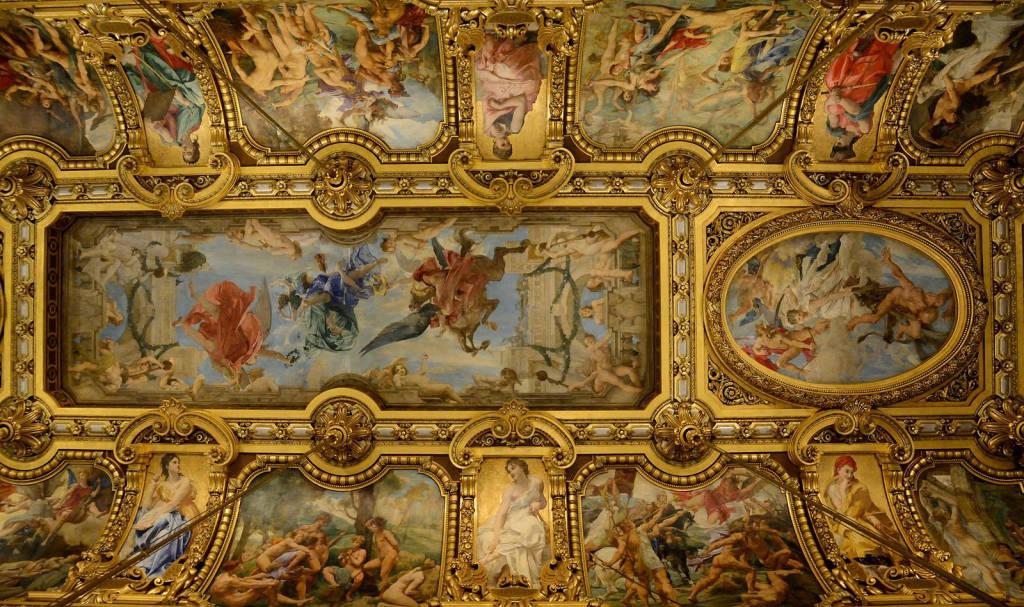
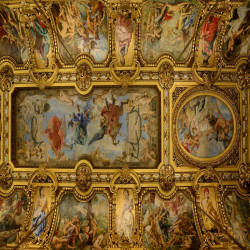
The theater auditorium has 1,979 seats, arranged in a traditional Italian horseshoe layout. The stage can accommodate up to 450 artists, considered the largest stage in Europe. The special feature of the auditorium lies in the crown-shaped dome. It consists of a large space in the center, decorated with drawings depicting scenes from operas by 14 composers - Mussorgsky, Mozart, Wagner, Berlioz, Rameau, Debussy, Ravel, Stravinsky, Tchaikovsky, Adam, Bizet, Verdi, Beethoven and Gluck, combined with a chandelier weighing up to 7 tons.
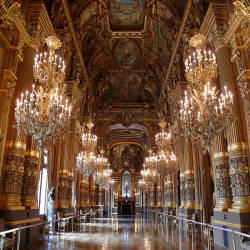
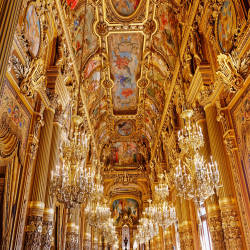
All rooms are lavishly decorated with intricate carvings, flaming bronze details, massive chandeliers and beautiful classical Renaissance paintings. Under the shimmering golden light, the theater space exudes a noble, luxurious and equally fanciful look.
Below this theater, there is also a power plant built to ensure stable power for the whole building. At the premiere of Aida (Verdi) in France in 1881, the performance was shown without the use of gas lamps. This also opened a new way of enjoying the work for the upper class at that time. All lights are focused on the stage, only the stage is the focus of all eyes. It was also the place where the phonograph and the téàtrophone were first tested.
The Palais Garnier Theater is an architectural monument with great influence. Many structures around the world have been built on the model of the Palais Garnier. For example, the Thomas Jefferson building in Washington DC, USA; Juliusz Słowacki Theater in Krakow, Poland; Theatro Municipal Theater in Rio de Janiro, Brazil and the Hanoi Opera House of Vietnam.