


 Tiếng ViệtEnglish
 한국어
 日本語
 简体中文
 Français
 Deutsch
 Español
 Italiano
 Русский


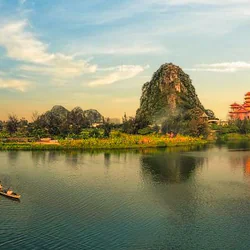
Ngu Hanh Son
 81 Huyen Tran Cong Chua, Ngu Hanh Son Ward, Da Nang City, Vietnam
Located about 8 km from central Da Nang, the Marble Mountains feature limestone peaks, natural caves, ancient pagodas and the traditional Non Nuoc stone-carving village. A fascinating destination for nature and culture lovers.
1. Five Mountains from a Single Egg?
Did you know that according to a Cham legend, the five peaks of today's Marble Mountains (Ngu Hanh Son) were formed from the eggshells of a giant sea dragon?
Look at the rocky cliffs right before you. It is hard to imagine that the ancients once explained the formation of this mountain range through such an extraordinary tale.
Yet the Marble Mountains hold another fascinating story. This place was once named by Emperor Minh Mang after the five elements: Metal, Wood, Water, Fire, and Earth.
So, how did legend and history come together in this land?
2. The Legend of the Sea Dragon's Egg
According to folk legend tied to the Marble Mountains, long ago a giant sea dragon laid an enormous egg along the seashore.
After some time, a beautiful maiden hatched from the egg, while the remaining eggshell fragments transformed into five mountains.
Later generations associated these five peaks with the Eastern theory of the Five Elements: Metal, Wood, Water, Fire, and Earth.
This was how people of the past used their imagination to explain the natural landscape around them. The story also reflects the imprint of Cham culture in the legends passed down through this region.
However, the history of the Marble Mountains is also recorded in concrete historical documents.
Before the name Ngu Hanh Son appeared in official chronicles, local residents affectionately knew this area by a familiar name: Non Nuoc.
That name entered folk literature through two well-known verses: "Every afternoon, clouds shroud Son Tra, Thunder rumbles over Non Nuoc as rain draws near."
This folk verse evokes the coastal landscape of Da Nang, where Son Tra Mountain and Non Nuoc have stood together in the collective memory of locals across generations.
In 1806, the name Ngu Hanh Son was recorded in the work Hoang Viet Nhat Thong Du Dia Chi (Imperial Unified Gazetteer of Vietnam) by Le Quang Dinh.
In 1825, Emperor Minh Mang visited this site. By 1837, the emperor officially named the mountains after the Five Elements.
From then on, the names Kim Son (Metal), Moc Son (Wood), Thuy Son (Water), Hoa Son (Fire), and Tho Son (Earth) were recorded in historical annals.
3. What Makes the Mountain You Are Exploring Special?
The Marble Mountains are located about 8 km southeast of Da Nang city center.
The cluster consists of five limestone mountains. Hoa Son alone is divided into Am Hoa Son (Yin Fire Mountain) and Duong Hoa Son (Yang Fire Mountain), giving the entire area six peaks in total.
Among them, Thuy Son (Water Mountain) is the largest and most famous peak, home to numerous caves, ancient pagodas, and scenic viewpoints.
If you are walking up the stone steps to ascend the mountain, take a moment to observe the rock surfaces beneath your feet. Signs of weathering, exposed rock formations, and sheer cliffs reveal a natural transformation spanning ages.
Rainwater seeps into rock crevices, dissolving and eroding the limestone to gradually carve out distinctive caves and geological formations.
That is also why the caves inside Thuy Son feature vastly different structures and lighting conditions.
One remarkable highlight is Huyen Khong Cave.
As you step inside, look up toward the cavern dome. Natural sunlight streams through openings in the stone ceiling, illuminating the space below.
You will notice that this is not a completely enclosed cave. The interplay of natural light and open space creates the signature beauty of Huyen Khong.
4. Discovering Buddhist Relics and Cham Culture
Along your journey exploring Thuy Son, you will encounter ancient pagodas such as Tam Thai Pagoda and Linh Ung Pagoda.
Take a little time to observe the architecture of the pagoda gates, tiled roofs, and decorative details. These relics demonstrate how Buddhist life has been intertwined with the Marble Mountains for generations.
Tam Thai Pagoda boasts a long history and was once restored under the patronage of Emperor Minh Mang. Nestled within the rocky mountain landscape, the pagoda offers a serene pause along your sightseeing route.
Continuing through the caves, you will discover sacred shrines arranged right inside the heart of the mountain.
Here, Buddhist beliefs blend seamlessly into the natural scenery. Statues, altars, and sacred relics set amidst stone cliffs create a truly unique spiritual atmosphere.
Another notable feature is the Cham cultural relics found across the Marble Mountains area. They remind us that this land once belonged to the Champa cultural sphere before becoming part of the history of Dang Trong and Vietnam.
If you have time, stop at scenic viewpoints such as Vong Giang Dai (River-Watching Pavilion). From here, you can look out over the river and surrounding neighborhoods below, gaining a clear sense of the mountain cluster's position across the coastal plain.
5. From Mountain Stone to Artisans' Hands
Upon leaving the mountain area, you can visit the Non Nuoc Stone Carving Village right at the foot of the Marble Mountains.
This craft village has a history of over 400 years, closely tied to the livelihood and development of the local community.
Take a moment to watch an artisan at work.
Starting from a raw block of stone, the craftsman must select the material, sketch the form, chisel, and refine every single detail. A single sculpture can go through numerous stages before taking shape.
The fine lines on stone statues and the intricate carvings on their surfaces demand immense patience and experience.
This is the fascinating connection between the Marble Mountains and Non Nuoc Village.
On one side are stone formations sculpted by nature over millions of years. On the other are works of art shaped by human hands across generations.
The Marble Mountains therefore hold a very special value: you can learn history through chronicles, hear legends through folk tales, observe spiritual relics inside caves, and witness a traditional handicraft thriving at the foot of the peaks.
Before concluding your journey, recall the story of the sea dragon's egg from the beginning of your visit.
It may only be a legend, yet stories like these helped the ancients preserve their perspective on the land they called home.
And now, having explored the Marble Mountains firsthand, you can feel for yourself why these five peaks have become such an iconic landmark of Da Nang.
ADDITIONAL INFORMATION
Opening Hours: 07:00 - 17:30 daily.
Reference Ticket Prices:
Thuy Son sightseeing: VND 40,000 / adult.
Am Phu Cave: VND 20,000 / adult (separate ticket).
Thuy Son elevator: VND 15,000 / one-way, VND 30,000 / round-trip.
Children under 6 years old: Free of charge according to published admission policy.
Experience Duration: Approximately 2-3 hours if focusing on Thuy Son. You can spend 3-4 hours for a thorough exploration of the caves, pagodas, and scenic viewpoints.
Suitable For:
Lovers of nature, caves, and geology.
Travelers interested in history, Cham culture, and Buddhism.
Visitors who enjoy light trekking, photography, and sightseeing.
Families with older children, groups of friends, and independent travelers.
Notes: There are many stone steps, steep slopes, and cave pathways. Wear shoes with good grip, bring drinking water, and exercise caution during rainy weather.
Nearby Attractions:
Non Nuoc Stone Carving Village: Right at the foot of the Marble Mountains.
Non Nuoc Beach: Coastal area adjacent to the scenic site.
My Khe Beach: About 5-7 km away.
Da Nang Museum of Cham Sculpture: About 7-8 km away.
Hoi An Ancient Town: About 20-22 km away.