


 Tiếng ViệtEnglish
 한국어
한국어 日本語
日本語 简体中文
简体中文 Français
 Deutsch
 Español
 Italiano
 Русский


 Login for Corporates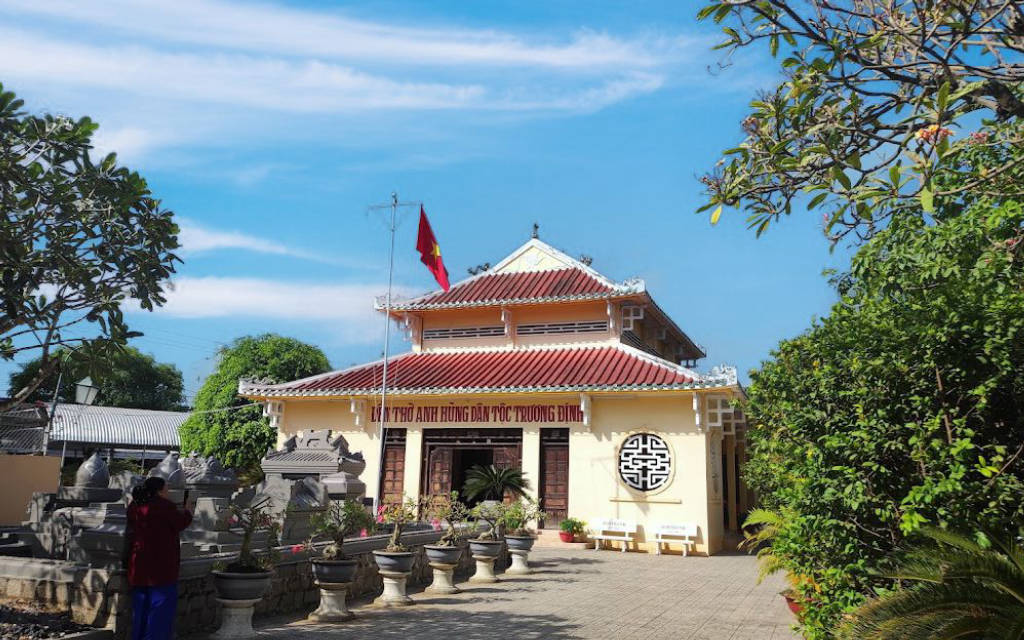
The Tomb and Temple of Trương Định
 1 Phan Dinh Phung Street, Ward 1, Go Cong City, Tien Giang Province, Vietnam
The Tomb and Temple of Trương Định (or Truong Cong Dinh Mausoleum), located at 1 Phan Dinh Phung Street, Ward 1, Go Cong City, Tien Giang Province, is a national historical and cultural relic recognized on December 6, 1989. The mausoleum worships national hero Truong Dinh, who devoted his life to the resistance war against French colonialism, and this is an ideal destination for those who want to learn about national history, explore traditional culture through a sacred and meaningful journey.
The Tomb and Temple of Trương Định in Gò Công, Tiền Giang, is a national historical site, dedicated to honoring the national hero Trương Định. The tomb is built in the traditional Southern Vietnamese burial architecture, combined with an Eastern-style temple. It is an ideal destination for those who wish to learn about history and culture and to remember the contributions of the hero who fought against French colonialism.
A Brief Overview of the National Hero Trương Định
Trương Định (1820–1864), from Quảng Ngãi, was the son of the official Trương Cầm. In 1844, he followed his father to the south and married Le Thị Thưởng. After his father’s death, Trương Định settled in his wife’s hometown in Tân Hòa, Gò Công.
In 1854, he participated in the government’s land reclamation policy, cultivating land and serving as Deputy Governor of Gia Thuận. During this time, he married Trần Thị Sanh, who was related to the royal family.
When French colonists invaded the Eastern Southern provinces, the imperial court signed a peace treaty, ceding three provinces to France. Trương Định was ordered to disband his forces, but he refused. He was given the title "Bình Tây Đại Nguyên Soái" (Great Commander of the West), a title bestowed by the people, and continued his resistance against the French.
On August 20, 1864, after a long period of resistance in the bases, he was surrounded by enemy troops at the “Dark Leaf Patch.” Trương Định withdrew his forces to Lý Nhơn to rebuild his army and launch a stronger resistance. Despite being pursued, he continued to call on scholars and patriots to rise up and protect the nation.
On the night of August 19, 1864, after being betrayed, he was surrounded at his house. Although he fought fiercely and killed several enemy soldiers, Trương Định was gravely wounded. Realizing he could not survive and did not want to fall into enemy hands, he took his own life on the morning of August 20, 1864, at the age of 44.
Trương Định became a national hero, symbolizing patriotism and the indomitable spirit of resistance against foreign invaders.
History of the Construction of Trương Định’s Tomb
After Trương Định’s death in 1864, his second wife, Trần Thị Sanh, brought his body back to Gò Công and organized a solemn burial. The tomb was built with "ô dước" mortar, and an inscription was carved reading: "The Tomb of Trương Công Định, Great General of the West, Leader of the Army and Defender of the Southern Frontiers of Dai Nam". However, the French colonists ordered the removal of the phrase "Bình Tây Đại Tướng Quân" (Great General of the West) and imposed fines on Mrs. Sanh.
In 1874, Mrs. Trần Thị Sanh petitioned to rebuild the tomb, and it was finally constructed in solid stone and granite to honor the patriot’s legacy. Throughout the French colonial period, the tomb faced numerous difficulties and restrictions.
In 1964, the tomb was renovated, and the temple was added in 1972. The temple was completed in 1973 with traditional Eastern-style architecture, becoming a sacred place where people from all over come to offer incense and honor Trương Định’s contributions.
Architecture of the Tomb and Temple of Trương Định – Ancient Beauty and Spirituality
Trương Định’s tomb is a typical historical site reflecting the Southern Vietnamese burial architecture. The tomb consists of two main parts: the tomb area and the temple.
The tomb of Trương Định covers an area of 67 m² and is built using “ong” stone and "ô dước" mortar. The tombstone bears his title: “Đại Nam Thần Dõng, Đại tướng quân, Truy tặng Ngũ Quân, Ngũ Quận Công Trương Công Định chi mộ” (The Tomb of the Great General Trương Công Định, posthumously awarded by the court), along with the words “Trung Nghĩa” (Loyalty and Righteousness) and a couplet: “Sơn Hà Thu Chính Khí, Nhật Nguyệt Chiếu Đan Tâm” – reflecting the patriotism and loyalty of the hero.
The temple near the tomb follows Eastern architectural styles, with an imposing yet ancient design. Inside, you’ll find altars, horizontal beams, and decorative motifs gilded with gold leaf. The temple exudes a solemn and sacred atmosphere, attracting many visitors to come for cultural and spiritual experiences.
Related Sites to Visit
In addition to the tomb of Trương Định in Gò Công, visitors can also visit other temples dedicated to him in Tiền Giang. Notably, in Gia Thuận Commune, Gò Công Đông District, there is another temple known as “Đám lá tối trời” (The Dark Leaf Patch), where Trương Định and his troops set up a resistance base. These memorial sites not only honor the national hero but also preserve the cultural traditions and customs of the Vietnamese people.
The Tomb and Temple of Trương Định in Gò Công is a meaningful destination, offering a unique cultural and historical experience for travelers. Here, you will have the opportunity to learn more about the Great General of the West, who dedicated his life to the journey into history but also a spiritual journey, awakening a sense of pride and patriotism.