


See all results for ""

 Anytime
 Tiếng ViệtEnglish
 한국어
한국어 日本語
日本語 简体中文
简体中文 Français
 Deutsch
 Español
 Italiano
 Русский


 Login for Corporates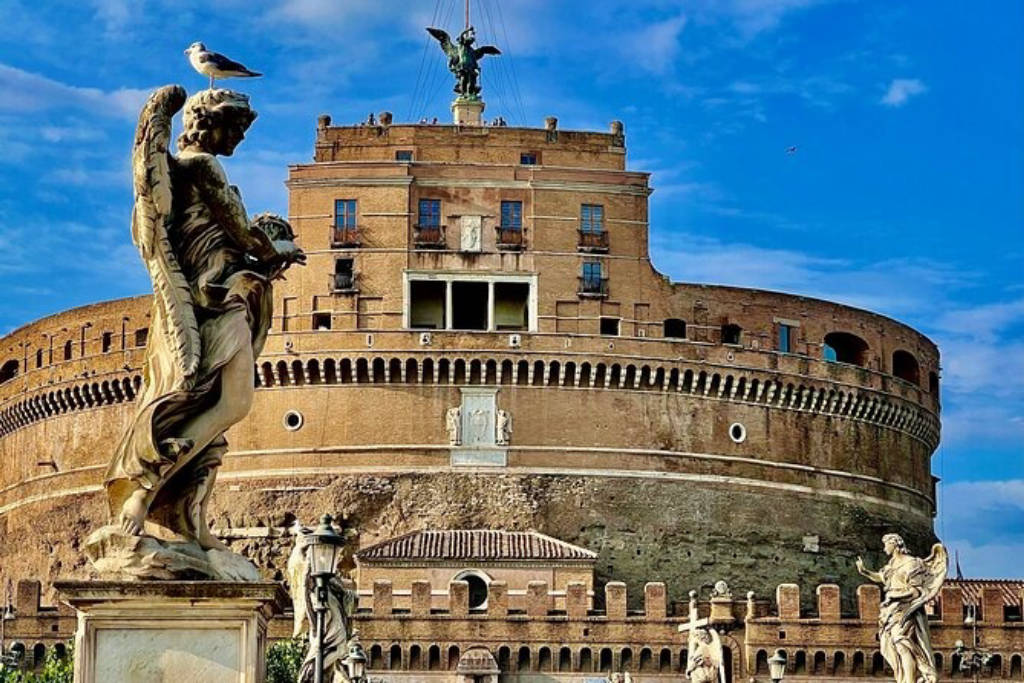
Castel Sant'Angelo
 Lungotevere Castello, 50, 00186 Roma RM, Italy
Hadrian's Mausoleum, also known as Castel Sant'Angelo, is a giant cylindrical structure with extremely rich historical values.
Hadrian's Mausoleum, also known as Castel Sant'Angelo, is a giant cylindrical structure in Parco Adriano, Rome, Italy. Hadrian, Roman Emperor, originally commissioned it as a mausoleum for himself and his family. This structure was later used by the popes as a fortress and castle. Until today, this place has become a museum. In the past, this was Rome's tallest structure. Castel Sant'Angelo is at Lungotevere Castello, 50, 00193 Roma RM, Italy.
Between AD 134 and 139, the tomb of the Roman emperor Hadrian was built on the right bank of the Tiber River. The mausoleum was once a beautiful cylindrical campus with a gilded garden top and tower top. Hadrian's ashes, along with his wife Sabina and his first adopted son Lucius Aelius, were buried here a year after his death in Baiae in 138. Thereafter, the bodies of the following emperors were buried. buried here, with Caracalla being the most recent to be buried here in 217. These urns are located deep inside the building, what is now known as the Treasury Room.
Since the building was converted into a military stronghold in 401 and later inserted into the Aurelian Wall by Flavius Honorius Augustus, much of the remains and decorations of the tomb have been destroyed. pass away. According to Procopius, the original beautiful bronze and stone statue was hurled down at the attacking Goths when they besieged Rome in 537. And, urns of ashes and ashes were scattered by the Visigoth band of robbers during the siege. Alaric's destruction of Rome in 410.
It was decommissioned in 1901 after being turned into a prison, barracks, and even a warehouse for war equipment. Colonel Luigi Durand de la Penne and Captain Mariano Borgatti agreed to rebuild the Mausoleum after it had been abandoned for a long time. King Vittorio Emanuele III reopened Hadrian's Mausoleum as a museum after a six-year renovation project. Visitors can view the famous outdoor landscape, reconstructed 15th-century shops, various works of art, statues and frescoes, and even enter the Pope's Apartment, which is decorated with actual historical pieces, inside the Castel Sant Angelo. The most prominent here are the paintings, Passetto di Borgo, and Ponte Sant'Angelo.
The Passetto di Borgo connects Castel Sant'Angelo with Vatican City by an elevated walkway. Pope Nicholas III authorized the construction of this 800-meter-long walkway in 1277. During this time, the citadel also served as the Pope's residence. In the event of an attack, the corridor acts as a safe haven for the Popes. When Charles VIII conquered Rome in 1494, Pope Alexander VI used it. King Clement VII also passed by it during the Sack of Rome in 1527. The passage can be seen from the castle and it is sometimes open to the public in the summer.
Ponte Sant'Angelo is a bridge over the Tiber River, connecting Castel Sant'Angelo with the rest of the city. Emperor Hadrian built the bridge 135 meters long. It was used by Christian pilgrims as a gateway to St Peter's Basilica and was originally known as the Aelian Bridge or Hadrian's Bridge. When the statue of the Archangel Michael was built at the mausoleum in the 7th century, the bridge was named Ponte Sant'Angelo. The Pope commissioned Gian Lorenzo Bernini to carve ten angels raised on either side of the bridge during the Renaissance.