


See all results for ""

 Anytime
 Tiếng ViệtEnglish
 한국어
한국어 日本語
日本語 简体中文
简体中文 Français
 Deutsch
 Español
 Italiano
 Русский


 Login for Corporates
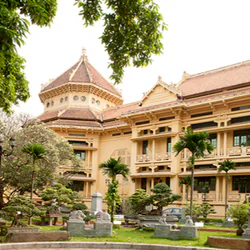
National Museum of Vietnamese History
 1 Trang Tien Street, Phan Chu Trinh Ward, Hoan Kiem District, Hanoi City, Vietnam
Located in the heart of Hanoi, the National Museum of Vietnamese History is a key cultural site that preserves and exhibits an extensive collection of valuable historical artifacts and documents. With a mission to protect and promote the nation's cultural heritage, the museum plays an active role in the country's ongoing development.
The museum offers a multidimensional journey through Vietnamese history, with two main exhibition sites at 1 Trang Tien and 216 Tran Quang Khai, covering eras from prehistoric to modern times.
Located in the heart of Hanoi, the National Museum of Vietnamese History is a key cultural site that preserves and exhibits an extensive collection of valuable historical artifacts and documents. With a mission to protect and promote the nation's cultural heritage, the museum plays an active role in the country's ongoing development. The museum offers a multidimensional journey through Vietnamese history, with two main exhibition sites at 1 Trang Tien and 216 Tran Quang Khai, covering eras from prehistoric to modern times. The museum at 1 Trang Tien, originally built by the French in 1926, uniquely combines Eastern and Western architectural styles. In 1958, it was transformed into a museum dedicated to Vietnamese history from prehistoric times up until the Nguyen Dynasty (1945). Today, it focuses on two primary periods:
**1. Prehistoric Vietnam** Exhibits feature relics from the Old Stone Age to the New Stone Age, revealing the first signs of human life in Vietnam. Artifacts such as tools from Nui Do and Nguom caves demonstrate early stone and ceramic craftsmanship. The New Stone Age showcases advances in stone tool-making, pottery, and early agriculture, laying the foundation for indigenous culture. **2. The Early State-Building Period in Vietnam** Vietnam developed early metallurgical skills and established three major cultural centers:
- **Dong Son Culture**: Known for its famous Dong Son bronze drums, symbol of power during the Hung Kings' era, reflect the rich life of ancient Vietnamese people. - **Sa Huynh Culture**: Flourishing in Central Vietnam, this culture is characterized by jar burials and exquisite jewelry, forming the cultural base of the Cham Kingdom. - **Dong Nai Culture**: Developed in the lower Dong Nai River region, laying the groundwork for later Oc Eo culture. **Vietnam in the First to Tenth Centuries AD:** Despite periods of Chinese domination, this era saw numerous independence movements and the formation of Vietnam's early feudal dynasties, including the Ngo, Dinh, Early Le, Ly, Tran, and Ho dynasties . **Subsequent Feudal Dynasties:** The museum introduces the Later Le, Mac, Tay Son, and Nguyen dynasties, highlighting significant historical events of these periods. The building at 216 Tran Quang Khai (formerly the Museum of the Vietnamese Revolution) showcases Vietnam's history from the mid-19th century onward. Its exhibits cover:
1. **The Struggle for Independence (1858–1945)**: Displaying movements from the French invasion to the August Revolution of 1945, this section includes notable uprisings like Ba Dinh, Yen The, Can Vuong, and nationalist campaigns such as Dong Du and Duy Tan, highlighting the role of the Communist Party and Nguyen Ai Quoc (Ho Chi Minh). 2. **Resistance Against French Colonialism (1946–1954)**: This area highlights the national defense, from the All-People’s Resistance to the victory at Dien Bien Phu. 3. **The Struggle Against American Imperialism and National Reunification (1955–1975)**: Featuring key victories from the Dong Khoi movement to the Ho Chi Minh campaign of 1975, illustrating the efforts to overcome hardships and achieve independence and unity. 4. **Nation-Building from 1976 to the Present**: Summarizing Vietnam’s development under the Party’s leadership, including advancements in economics, culture, and politics during the reform period.